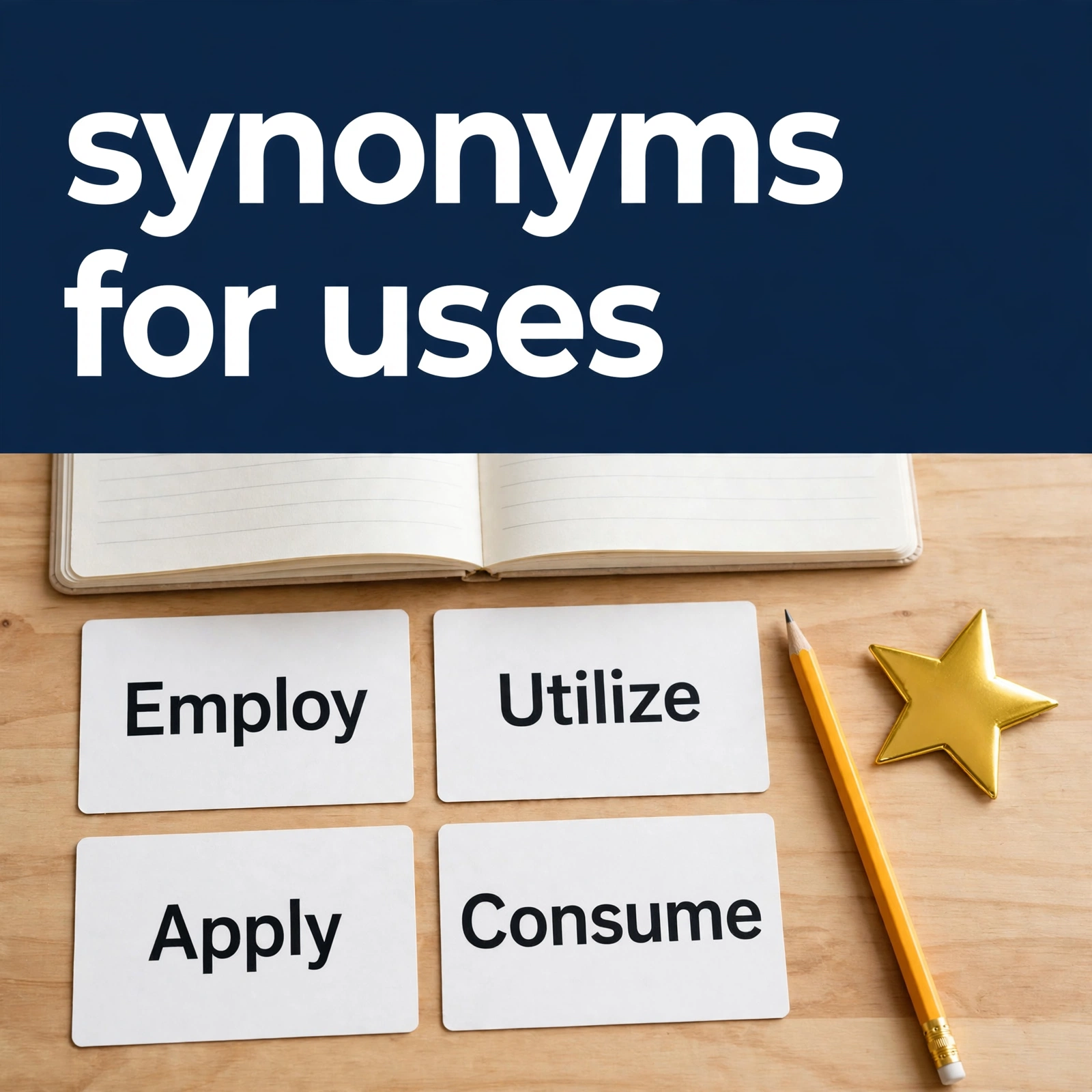
18 Synonyms for Uses: Better Words for Writing
“She uses a pen to write.” “He uses his time well.” “The uses of this tool are many.” Uses is a small word, but it does three very different jobs. It can mean putting something to work, like using a hammer. It can mean spending something up, like using all the milk. And it can mean the purposes a thing serves, like the uses of a word.
That is why uses can mislead a reader. If you write “he used her,” you may mean he asked for her help. If you write “he used her,” you may also mean he took unfair advantage of her. One word covers honest work and selfish gain, so readers have to guess which one you mean.
This guide gives you 18 synonyms for uses, grouped by that job. You will learn which words fit putting something to work, which words fit spending or taking advantage, and which words fit the purposes of a thing, so you can pick the word that says exactly what you mean.
Quick Answer
For putting something to work, use employ, utilize, or apply. For spending something up, use consume, spend, or exhaust. For the purposes of a thing, use application, purpose, or function. The best choice depends on whether you mean the act of using, the thing being spent, or the purpose it serves. These synonyms for uses will help you choose the right word for each job.
What Does Uses Mean?
Uses is the form of use for he, she, or it in the present tense, and it is also the plural noun for the purposes of a thing. As a verb, use means to put something into service for a purpose: “she uses a map to find the road.” As a noun, use means the act of employing something, or the purpose it serves: “the uses of a knife are many.”
The sense changes with the job. With a tool, uses can mean honest work: “he uses a saw to cut wood.” With a supply, uses can mean spending it up: “we used all the paint on the wall.” With a person, uses can mean unfair gain: “he used his friend to get the job.” With a word or a tool, uses as a noun can mean its purposes: “the uses of the word point are many.”
That move is why uses can mislead a reader. If you write “she used the money,” your reader cannot tell whether she spent it wisely, spent it all, or wasted it. Naming the exact job fixes the problem at once, and the words below do that job.
You can compare these senses in the Merriam-Webster thesaurus entry for use.
Synonyms for Putting Something to Work
Use these when uses means putting a thing, a skill, or a person into service for a purpose.
- Employ: Means to put something into service, often a person or a skill that is ready but idle. It fits a worker, a tool, and a method. Example: The teacher employed a song to help the class learn the new words.
- Utilize: Means to make practical use of something, often in a new or clever way. It fits a tool, a room, and a skill. Example: The cook utilized the old bucket as a pot for the plants.
- Apply: Means to put something to use for a clear purpose, often a rule, a skill, or a cream. It fits a student, a worker, and a nurse. Example: The student applied what she learned to the test.
- Operate: Means to use and control a machine or a system. It fits a driver, a worker, and a pilot. Example: The worker operated the crane to lift the heavy boxes.
- Wield: Means to hold and use a tool or a weapon with skill. It fits a worker, a writer, and a soldier. Example: The writer wielded her pen to tell the story of her village.
- Handle: Means to use something with your hands, often with care or skill. It fits a cook, a driver, and a worker. Example: The cook handled the hot pan with a thick cloth.
Synonyms for Spending or Taking Advantage
Use these when uses means spending something up, or using a person in an unfair way.
- Consume: Means to use something up, often food, fuel, or time. It fits a family, a car, and a reader. Example: The family consumed all the bread before the guests came.
- Spend: Means to use money, time, or energy until it is gone. It fits a shopper, a student, and a traveller. Example: She spent her whole morning on the long letter.
- Exhaust: Means to use something up until nothing is left. It fits a worker, a team, and a country. Example: The runners exhausted their strength before the race ended.
- Deplete: Means to reduce a supply until it is very low. It fits a store, a farm, and a bank. Example: The long dry season depleted the water in the wells.
- Exploit: Means to use someone or something for your own gain, often in an unfair way. It fits a boss, a company, and a cheat. Example: The factory exploited its workers by paying them very little.
- Manipulate: Means to use a person or a thing in a clever but unfair way to get what you want. It fits a cheat, a trader, and a speaker. Example: The cheat manipulated his friend into lending him money.
Synonyms for the Purposes of a Thing
Use these when uses is a noun that means the purposes, jobs, or value of a thing.
- Application: Means the act of putting something to a purpose, or one of its uses. It fits a tool, a rule, and a word. Example: One application of this cream is to heal small cuts.
- Purpose: Means the reason a thing exists or is used. It fits a tool, a room, and a gift. Example: The purpose of the bell is to call the class inside.
- Function: Means the job a thing is made to do. It fits a machine, a part, and a word. Example: The function of the heart is to move blood through the body.
- Utility: Means the quality of being useful for a purpose. It fits a tool, a room, and a skill. Example: The utility of a good knife is clear in every kitchen.
- Usefulness: Means how much help a thing gives. It fits a book, a tool, and a friend. Example: The usefulness of the map was clear on the long road.
- Service: Means the work a thing does for someone, or its use in helping. It fits a car, a phone, and a worker. Example: The old bus gave good service to the village for many years.
How to Choose the Right Word
Ask three short questions before you replace uses, and use them to pick the right synonyms for uses for your sentence:
- Are you putting something to work, spending it, or naming its purpose? Employ, utilize, and apply fit putting something to work. Consume, spend, and exhaust fit spending it up. Application, purpose, and function fit its purpose as a noun.
- Is the use fair or unfair? Employ and apply are neutral and fair. Exploit and manipulate are unfair: they mean using a person for selfish gain. Do not use exploit for honest work.
- Is the thing a tool, a supply, or a purpose? Operate and wield fit a tool or a machine. Consume and deplete fit a supply like food or water. Function and utility fit the purpose a thing serves.
| Situation | Better choice | Why it works |
|---|---|---|
| A teacher puts a song to work in class | employ | It means putting a ready skill or thing into service. |
| A family eats all the bread | consume | It means using food up until it is gone. |
| A boss pays workers very little for gain | exploit | It means using people in an unfair way. |
| The job a heart is made to do | function | It means the work a thing is made for. |
If you are unsure, choose the plainer word. Among these synonyms for uses, use is safer than utilize in everyday writing, and employ is safer than exploit unless the use is truly unfair.
Sentence Examples
These before-and-after examples show how synonyms for uses get sharper in real sentences:
- Before: She uses a song in class. After: She employs a song in class. The change says she puts a ready thing into service.
- Before: They used all the bread. After: They consumed all the bread. The change says the food was eaten up.
- Before: He used his friend to get the job. After: He exploited his friend to get the job. The change says the use was unfair.
- Before: The uses of a knife are many. After: The applications of a knife are many. The change names its purposes in a formal way.
- Before: The heart has many uses. After: The function of the heart is to move blood through the body. The change says the heart’s job, not an act of using.
Grammar and Common Mistakes
- Use, uses, used, and using: Use is the base verb, uses is for he, she, or it, used is the past form, and using is the -ing form. Write “she uses a pen,” “he used a pen,” and “she is using a pen.”
- Used to and be used to are different: “Used to” means a past habit: “I used to walk to school.” “Be used to” means being familiar with something: “I am used to the cold.” Do not mix them.
- Use up means use until nothing is left: “We used up all the milk” means no milk is left. Plain “use” does not say the supply is gone.
- Utilize is not always better than use: Utilize fits a new or practical use, like an old bucket as a planter. For a plain act, use is shorter and clearer.
- Exploit is always negative: Exploit means unfair gain. Do not use it for honest work, like using a map or a tool.
- Uses as a noun takes a plural verb: “The uses of this word are many” is right. “The uses of this word is many” is wrong.
For the full dictionary senses, see the Cambridge Dictionary entry for use.
Frequently Asked Questions About Synonyms for Uses
What is the best synonym for uses in an essay?
It depends on the job. For putting something to work, use employ or apply. For spending something up, use consume or exhaust. For the purposes of a thing, use application or function. Match the word to the job.
What is the difference between use and utilize?
Use is the plain word for putting something into service. Utilize often means finding a new or practical use for it, like an old bucket used as a planter. In most sentences, use is the clearer choice.
What is the difference between employ and use?
Employ often means putting a person or a skill that is ready but idle into service, like employing a worker or a method. Use is wider and fits any act of putting something to work.
What does exploit mean?
It means to use someone or something for your own gain in an unfair way, like a factory paying workers very little. Use it only when the gain is unfair.
Can application replace uses?
Yes, as a noun. “The applications of this tool are many” means its uses are many. As a verb, use apply instead: “she applied the rule to the test.”
When should I use consume instead of use?
Use consume when the thing is eaten, burned, or spent until it is gone, like food, fuel, or time. For a tool or a skill, use employ, apply, or operate instead.
Conclusion
These synonyms for uses cover three different jobs: putting something to work, spending something up, and naming the purposes of a thing. Employ, utilize, apply, operate, wield, and handle name putting something to work. Consume, spend, exhaust, deplete, exploit, and manipulate name spending it up or using it unfairly. Application, purpose, function, utility, usefulness, and service name the purposes of a thing. Pick the synonyms for uses that name the job in your sentence, and your writing will say more with fewer words. Find more words like these in our Actions & Verbs Synonyms collection.