18 Synonyms for Scared: Better Words for Writing
18 Synonyms for Scared: Better Words for Writing
“I am scared of the dark.” “The loud noise scared the child.” “She was too scared to speak.” Scared is a short word, but it does three very different jobs. It can mean a little fear, like worry before a test. It can mean clear fear, like fear of a dog or a storm. And it can mean very great fear, like terror that leaves you unable to move.
That is why scared can mislead a reader. If you write “he was scared,” you may mean only that he was nervous. If you write “she was scared,” you may mean she was frozen with terror. One word covers a small worry and a great terror, so readers have to guess how strong the fear is.
This guide gives you 18 synonyms for scared, grouped by that job. You will learn which words fit a little fear, which words fit clear fear, and which words fit very great fear, so you can pick the word that says exactly how scared the person is.
Quick Answer
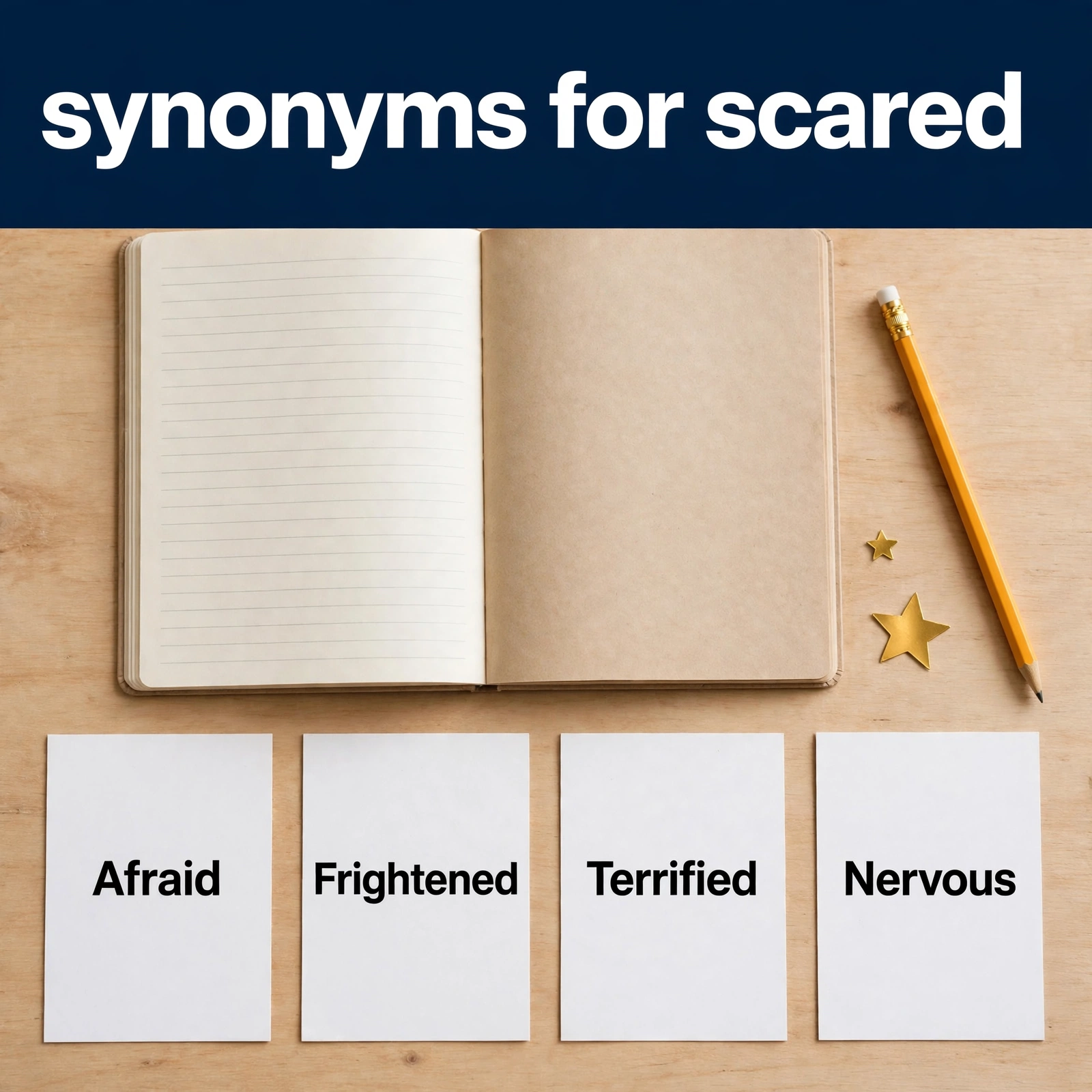
For a little fear, use worried, nervous, or uneasy. For clear fear, use afraid, frightened, or fearful. For very great fear, use terrified, petrified, or horrified. The best choice among these synonyms for scared depends on how strong the fear is, and whether it came on slowly or all at once. These synonyms for scared work in essays, stories, and everyday writing.
What Does Scared Mean?
Scared is an adjective. Its main sense is filled with fear or dread: a scared child feels fear in the face of danger, real or imagined. “I am scared of spiders” means spiders fill me with fear. “She was scared to tell her mother” means fear kept her from speaking.
The sense changes with the strength of the fear. With a small fear, scared can mean only worry: “I was scared you might not come” means I was worried, not terrified. With a sudden fear, scared can mean a quick fright: “the noise scared me” means the noise gave me a sudden fright. With a great fear, scared can mean terror: “he was too scared to run” means fear froze him in place.
That move is why scared can mislead a reader. If you write “the boy was scared,” your reader cannot tell whether he was only nervous, clearly frightened, or frozen with terror. Naming the exact strength fixes the problem at once, and the words below do that job.
You can compare these senses in the Merriam-Webster thesaurus entry for scared.
Synonyms for a Little Scared
Use these when scared means a small fear, worry, or unease, often before something happens.
- Worried: Means troubled by thoughts that something bad may happen. It fits a parent, a student, and a friend. Example: The worried mother waited at the door until her son came home.
- Nervous: Means tense and uneasy, often before a test, a speech, or a meeting. It fits a student, a singer, and a driver. Example: The nervous singer waited behind the curtain before her first song.
- Uneasy: Means not calm and not sure, with a small fear in the mind. It fits a traveller, a worker, and a child in the dark. Example: He felt uneasy in the quiet house, though nothing was wrong.
- Anxious: Means worried and troubled, often about the future. It fits a student, a mother, and a job seeker. Example: She was anxious about the test, so she read her notes twice.
- Apprehensive: Means fearful that something bad will happen, often before it starts. It fits a child, a patient, and a new worker. Example: The apprehensive boy stood at the gate of the new school.
- Jumpy: Means easily startled and nervous, ready to jump at a small sound. It is informal, and it fits a child and a tired traveller. Example: After the long night, the jumpy guard turned at every small noise.
Synonyms for Clearly Frightened
Use these when scared means clear fear of a thing, a person, or an event.
- Afraid: Means filled with fear. It is the plainest word in this group, and it fits a child, a traveller, and an animal. Example: The little girl was afraid of the dark, so her mother left a small lamp on.
- Frightened: Means filled with fear by something sudden or strong. It fits a child, a dog, and a crowd. Example: The frightened dog hid under the table when the thunder began.
- Fearful: Means full of fear, often for a long time. It fits a child, a village, and a traveller. Example: The fearful villagers stayed inside when the storm came near.
- Alarmed: Means suddenly worried by danger or bad news. It fits a parent, a guard, and a whole town. Example: The alarmed parents called the school when the children did not come home.
- Startled: Means given a sudden fright by a noise or a sight. It fits a child, a horse, and a sleeping cat. Example: The startled cat jumped off the wall when the door closed with a bang.
- Shocked: Means filled with sudden, strong surprise, often by bad news. It fits a crowd, a family, and a whole town. Example: The shocked crowd stood silent when they heard the sad news.
Synonyms for Very Scared
Use these when scared means very great fear, fear that is hard to control or that freezes the body.
- Terrified: Means filled with very great fear. It fits a child, a traveller, and a whole crowd. Example: The terrified children ran from the burning house to the safe road.
- Petrified: Means so scared that you cannot move, as if turned to stone. It fits a child on a high wall and a speaker on a stage. Example: He was petrified at the top of the tall tree and could not climb down.
- Horrified: Means filled with fear and shock at something terrible. It fits a witness, a mother, and a crowd. Example: The horrified mother held her child close when the car came near.
- Panicky: Means filled with sudden, uncontrolled fear. It fits a crowd, a child, and a swimmer in deep water. Example: The panicky crowd pushed towards the door when the alarm rang.
- Panic-stricken: Means filled with panic, unable to think clearly. It fits a mother, a traveller, and a whole village. Example: The panic-stricken mother searched the whole market for her lost son.
- Aghast: Means filled with horror and shock, unable to speak. It fits a witness, a friend, and a crowd. Example: The aghast crowd stared at the broken bridge in silence.
How to Choose the Right Word
When you choose synonyms for scared, ask three short questions before you replace scared:
- How strong is the fear? Worried, nervous, and uneasy fit a little fear. Afraid, frightened, and fearful fit clear fear. Terrified, petrified, and horrified fit very great fear. Do not use terrified for a small worry.
- Did the fear come slowly or all at once? Anxious and apprehensive fit a slow fear before something happens. Startled and shocked fit a sudden fear from a noise or bad news. A test makes a student anxious; a loud bang makes a child startled.
- Can the person still move and think? A nervous person can still act. A frightened person may run or hide. A petrified person cannot move at all, and a panic-stricken person cannot think clearly. Pick the word that shows what the fear does to the body.
| Situation | Better choice | Why it works |
|---|---|---|
| A student before a test | nervous | It means tense and uneasy before something. |
| A child who hears thunder | frightened | It means filled with fear by something strong. |
| A person who cannot move on a high wall | petrified | It means so scared you cannot move. |
| A crowd that hears a sudden alarm | panicky | It means sudden, uncontrolled fear. |
If you are unsure which synonyms for scared to use, choose the plainer word. Afraid is safer than apprehensive in everyday writing, and terrified is safer than aghast unless the fear comes with horror and shock.
Sentence Examples
These before-and-after examples show how synonyms for scared make the meaning sharper:
- Before: The boy was scared before the test. After: The boy was nervous before the test. The change says his fear was small and tense, not terror.
- Before: The girl was scared of the dog. After: The girl was afraid of the dog. The change names clear fear in plain words.
- Before: The man was scared on the high wall. After: The man was petrified on the high wall. The change says fear froze him, so he could not move.
- Before: The crowd was scared when the alarm rang. After: The crowd was panicky when the alarm rang. The change says the fear was sudden and uncontrolled.
- Before: She was scared by the news. After: She was shocked by the news. The change says the news gave her a sudden, strong surprise.
Grammar and Common Mistakes
- Scared of, scared to, and scared that: Write “scared of spiders” for a thing, “scared to tell her” for an action, and “scared that you might not come” for a thought. Do not write “scared from” in these senses.
- Fearful has two meanings: Fearful can mean full of fear, as in “a fearful child,” and it can also mean causing fear, as in “a fearful storm.” Make the sense clear from the sentence.
- Startled is not the same as scared for a long time: Startled means a sudden fright from a noise or a sight. It does not fit a long fear, like fear of the dark. Use afraid or fearful for a long fear.
- Petrified does not mean turned to stone: Petrified is a figure of speech. It means so scared that you cannot move, as if you were stone. Do not use it for a small fear.
- Do not use terrified for a small worry: Terrified means very great fear. A student before a test is nervous or anxious, not terrified, unless the fear is truly great.
- Scared is an adjective, scare is a verb: Write “I am scared” for the feeling and “the noise scared me” for the action. Do not write “the noise scared” without an object.
For the full dictionary senses, see the Cambridge Dictionary entry for scared.
Frequently Asked Questions About Synonyms for Scared
What is the best synonym for scared in an essay?
It depends on the strength. For a little fear, use worried or nervous. For clear fear, use afraid or frightened. For very great fear, use terrified or petrified. Match the word to the strength of the fear.
What is the difference between afraid and frightened?
Afraid is the plainest word for filled with fear. Frightened often means filled with fear by something sudden or strong, like thunder or a loud noise. In most sentences, afraid is the safer choice.
What is the difference between nervous and scared?
Nervous means tense and uneasy, often before something happens. Scared is wider: it can mean a little worry, clear fear, or great terror. A student before a test is nervous; a child in a storm is scared.
What does petrified mean?
It means so scared that you cannot move, as if turned to stone. Use it only for very great fear, not for a small worry.
Can shocked replace scared?
Only for a sudden fright from bad news or a surprise. “She was shocked by the news” is right. For a long fear, like fear of the dark, use afraid instead.
When should I use terrified instead of scared?
Use terrified when the fear is very great, like fear in a fire or a storm. For a small fear, use worried, nervous, or afraid instead.
Conclusion
Scared covers three different jobs: a little fear, clear fear, and very great fear. Worried, nervous, uneasy, anxious, apprehensive, and jumpy name a little fear. Afraid, frightened, fearful, alarmed, startled, and shocked name clear fear. Terrified, petrified, horrified, panicky, panic-stricken, and aghast name very great fear. Pick the word that names the strength of the fear in your sentence, and your writing will say more with fewer words.
These synonyms for scared give you a precise word for every level of fear, from a small worry to terror that freezes you. For more words about feelings, explore our Feelings & Emotions Synonyms collection.