10 Synonyms for Better: Clearer Words for Comparisons
Better is one of the most used words in English. It compares two things and says one wins: a better plan, a better score, a better day. That is also its weakness. It tells the reader something improved, but not how or by how much.
This guide gives you 10 synonyms for better, grouped by meaning. You will learn which words fit a higher standard, which phrases fit doing something well, and which verbs mean to improve something, so you can keep the comparison clear. Each word comes with a short note and a real example.
Quick Answer
For a higher standard, use superior or preferable. For an improved thing, use improved or finer. When better describes how well someone does something, rebuild the sentence with more effectively or more successfully. For the verb to better, use improve or enhance. Keep the comparison: better always means better than something. These synonyms for better are grouped by use, so start with the group that matches your sentence.
What Does Better Mean?
Better is the comparative form of good and well. As an adjective, it is the comparative of good: it describes a noun as higher in standard, quality, or suitability than something else. As an adverb, it is the comparative of well: it describes how an action is done, to a greater degree or in a more successful way. That comparison is the starting point for choosing synonyms for better in your own writing.
In both uses, better always compares. Sometimes the other side of the comparison is stated, as in “better than the old one.” Sometimes it is left out, as in “a better plan,” where the reader understands “better than the plan we had before.” If your reader cannot tell what is being compared, the sentence feels vague, and that is the moment to add the comparison back in.
Better is also a verb, meaning to improve something: “She hopes to better her exam score.” And in one everyday sense it means to recover health, as in “I hope you get better soon.” This guide focuses on the comparing uses and the verb sense, because those are the ones writers most often need to replace.
You can compare these senses in the Merriam-Webster thesaurus entry for better: https://www.merriam-webster.com/thesaurus/better?pronunciation&lang=en_us&dir=o&file=oblivi01
Synonyms for a Higher Standard (Comparative Adjective)
Use these when better describes a noun and compares it with another thing. Keep the comparison in the sentence, either with “than” or with a clear point of reference. These synonyms for better all keep the comparison clear, so the reader knows what is being compared.
- Superior: Means higher in quality or rank than something else. It is formal and strong, so it suits reports, reviews, and essays. Note the grammar: use “superior to,” not “superior than.” Example: The new model offers superior battery life to the old one.
- Improved: Means made better than a previous version. It is the safest choice when something has changed for the better over time. Example: The improved version loads faster than the old one.
- Finer: Means of higher quality, often with a sense of care, detail, or delicacy. It suits craft, writing, and design more than size or speed. Example: The second draft has a finer structure than the first.
- Greater: Means larger in amount, size, or importance. Use it for numbers, scope, and impact, not for taste or style. Example: The new hall holds a greater number of guests than the old one.
- Preferable: Means more suitable or more desirable, often as a matter of choice rather than measured quality. Like superior, it takes “to,” not “than.” Example: A morning meeting is preferable to an afternoon one.
Saying It Better as an Adverb (Doing Something Well)
When better describes a verb, it tells us how well someone does something: “She sings better,” “He works better with a plan.” Here better is the comparative of well, and there is often no single word you can drop in as a swap. The honest fix is to rebuild the sentence, not to hunt for one word. These synonyms for better work best when the sentence is rebuilt, not just swapped word for word.
Rebuilding works because it names the kind of improvement. If the gain is about results, use “more effectively.” Example: He works more effectively with a clear plan than without one. If the gain is about success, use “more successfully.” Example: She completed the second test more successfully than the first. If the gain is about skill, use “more skillfully.” Example: He plays the guitar more skillfully than he did last year. If the gain is about seeing, hearing, or understanding, use “more clearly.” Example: I can see more clearly with these glasses than with the old ones.
In each case, the comparison stays. “More effectively” on its own still asks “than what?” — so keep the second half of the comparison, or make it clear from the sentence before. That is the real rule for the adverb sense: change the wording if you like, but never drop the comparison.
Verbs: When “to Better” Means to Improve
Use these when better itself is the verb, meaning to make something better. In this sense, better takes an object: you better a score, a design, or a situation. These synonyms for better replace the verb directly, while keeping its object.
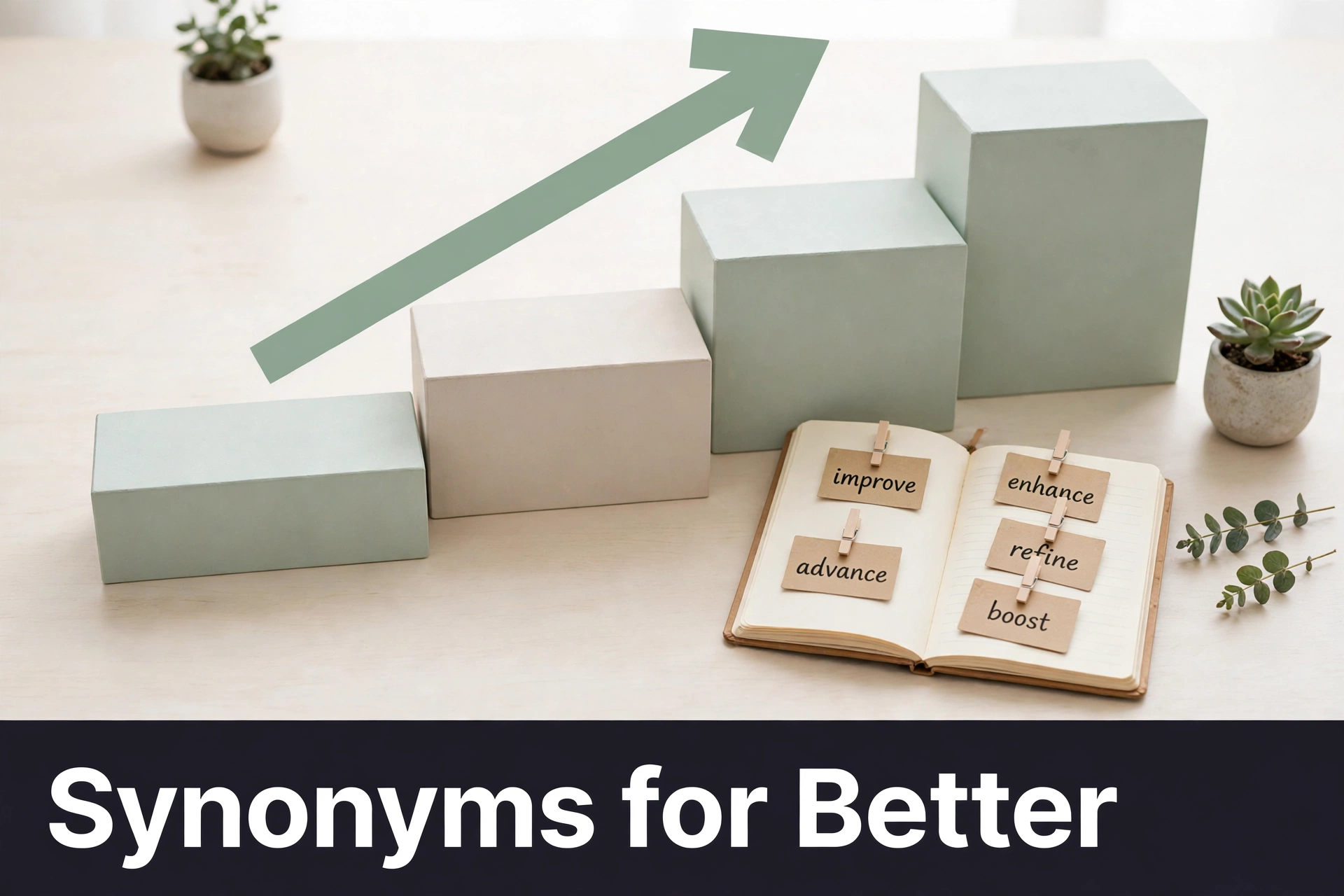
- Improve: The closest and most general verb for to better. It means to make something of higher quality or value. It fits almost any context. Example: She improved the report by adding clear headings.
- Enhance: Means to raise the quality, value, or appeal of something, often by adding a feature or a pleasing detail. It suits looks, sound, and experiences. Example: The new lights enhanced the photos.
- Refine: Means to improve something through small, careful changes. Use it when the work is nearly done and only needs polish. Example: He refined the design until it felt simple.
- Upgrade: Means to replace something with a newer or higher-quality version. It suits software, equipment, and services. Example: They upgraded the software to fix the errors.
- Boost: Means to raise the amount, energy, or performance of something. It is lively and direct, and it suits scores, sales, and confidence. Example: Good sleep boosted her test scores.
How to Choose the Right Word
Ask three short questions before you choose among synonyms for better:
- What is better doing? Describing a noun, describing an action, or acting as a verb?
- What improved? The quality, the amount, the skill, or the choice itself?
- What is it better than? If you cannot answer, add the comparison before you change the word.
| Situation | Better choice | Why it works |
|---|---|---|
| A product beats the old model | superior | It signals higher quality, and “superior to” keeps the grammar clean. |
| A new version of a draft | improved | It points to change over time, not just a higher rank. |
| A choice you would pick | preferable | It is about suitability and preference, not measured quality. |
| Doing a task with more success | more effectively | It names how the action improved, since no single word swaps in. |
| Making a design stronger | enhance / refine | Enhance adds appeal; refine polishes through small changes. |
If you are unsure, pick the plainer word. Improved is safer than superior in casual writing, and improve is safer than enhance when you mean a general gain.
Sentence Examples
These before-and-after examples show how synonyms for better make the meaning sharper:
- Before: This is a better phone. After: This phone offers superior battery life to the old one. The change says what is better, not just that something is.
- Before: Her second essay was better. After: Her second essay was improved, with clearer headings than the first. The change points to the revision behind the gain.
- Before: He works better now. After: He works more effectively now that he plans his day. The change names the kind of improvement and keeps the comparison.
- Before: A morning class is better. After: A morning class is preferable to an evening one. The change frames it as a choice, with the grammar to match.
- Before: We need to better the website. After: We need to enhance the website with faster pages. The change uses the verb sense and says how.
Grammar and Common Mistakes
- Better than, not “more better”: Better is already comparative, so “more better” is always wrong. Say “better than the old one,” not “more better than the old one.”
- Better vs. best: Better compares two things. Best picks the top of a group of three or more. Say “This one is better than that one,” but “This is the best of all the essays.”
- Better as adjective vs. adverb: Before a noun, better is an adjective, as in “a better plan.” After a verb, better is an adverb, as in “She plans better now.”
- Superior to and preferable to: Both take “to,” not “than.” Say “superior to the old model” and “preferable to the evening class.”
- Had better is advice, not comparison: In “You had better leave now,” had better means “you should.” It does not compare two things, so do not replace it with a synonym for better.
- Get better means recover: After an illness, “get better” means to return to health. In that sense, use recover or feel well again, not a comparison word.
For the full dictionary senses, see the Cambridge Dictionary entry for better: https://dictionary.cambridge.org/dictionary/english/better These dictionary senses help you choose synonyms for better with confidence.
Frequently Asked Questions
What is the best synonym for better in an essay?
It depends on your point. For quality, use superior. For a revised version, use improved. For a choice, use preferable. For the verb, use improve or enhance. Match the word to what actually improved, not just to a fancier word. That is why synonyms for better should match the point you are making, not just sound stronger.
Can I say “more better”?
No. Better already means “more good,” so adding more doubles the comparison. Say “better than” on its own. If you want extra force, use “much better” or “far better,” which are both correct.
What is the difference between better and best?
Better compares two things: “This essay is better than that one.” Best compares one thing with a whole group: “This is the best essay in the class.” Use better for pairs and best for a winner.
Is “superior than” correct?
No. Superior takes “to,” not “than.” Say “superior to the old model.” The same rule holds for preferable: “preferable to the evening class,” not “preferable than.”
What is a good verb synonym for “to better”?
Improve is the closest and most general choice. Enhance fits added appeal or value, refine fits small careful changes, and upgrade fits a newer version. Pick the verb that describes how the thing was made better.
Words to Explore Next
synonyms for good, synonyms for best, synonyms for improving
Conclusion
Better always compares. When you name what improved — the standard, the skill, or the thing itself — your writing gets sharper at once. Start with superior, preferable, improved, or enhance, and keep the “than” in view. If the comparison is missing, add it back. That one habit turns a vague “better” into a claim your reader can trust. For more words in this set, browse the Good, Great & Quality Synonyms archive. In short, synonyms for better are useful only when the comparison stays clear.