Synonyms for And: Better Ways to Join Ideas
And is one of the most used words in English. It joins words, phrases, and whole ideas, and it does this job so well that it is easy to use it again and again in the same paragraph. This guide to synonyms for and shows how to choose the clearest replacement.
The problem is not that and is wrong. The problem is that it hides the link between ideas. This guide gives you sentence-level ways to replace and, grouped by what you are really doing: joining nouns, adding a point, or showing what happens next. Each choice comes with a short note and a real example.
Quick Answer
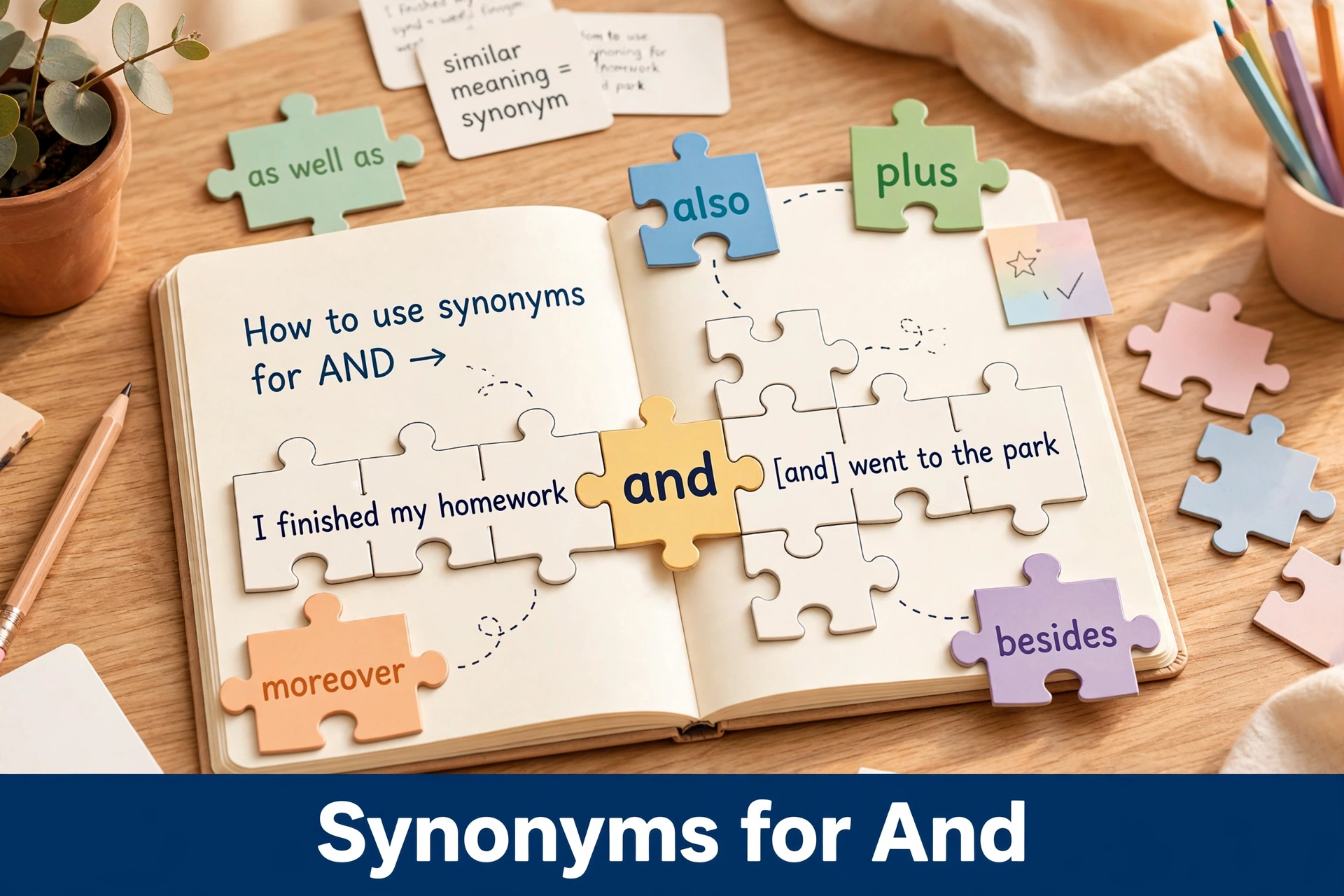
To join nouns, use as well as, along with, together with, or plus. To add a point in a new sentence, use in addition, additionally, moreover, furthermore, or besides. To show sequence, use then, after that, or next. Often, the clearest fix is a comma in a list, a semicolon, or a shorter sentence. These are the most useful synonyms for and at a glance.
What Does And Mean?
And is a coordinating conjunction. It joins two things of equal rank: two nouns, two verbs, two phrases, or two full sentences. It usually means “in addition to” or “together with,” but the exact link depends on the sentence. That meaning is why synonyms for and must match the link, not just the word.
- Joining nouns: “Tea and coffee are both hot drinks.” Both items count.
- Joining actions: “She read and took notes.” Both actions happened.
- Joining full sentences: “He finished work, and he went home.” Both sentences could stand alone.
- Adding a number or item: “Two and two are four.” Here and means plus.
And does not show contrast, cause, or order by itself. If you mean “but,” “because,” or “then,” say so. That is why a direct swap often fails: there is no single word that always replaces and. You need to name the link first, then pick the right tool.
You can compare these senses in the Merriam-Webster dictionary entry for and.
Joining Nouns and Phrases
Use these when and joins two nouns, two activities, or two phrases, and both belong together. For synonyms for and that join nouns, start with the choices below.
- As well as: Joins a second noun or activity to the first, with a little extra stress on the second item. Example: She teaches drawing as well as painting.
- Along with: Means “together with” a person or thing already named. Example: Along with her degree, she completed an internship.
- Together with: Means “in company with” or “combined with.” It suits formal writing. Example: Together with the guide, you will receive a map.
- Plus: A short, informal word for an added item or bonus. Example: The room is quiet, plus it has a sea view.
Do not use these to join two full sentences. “She finished work, plus she went home” sounds awkward. For full sentences, split them, use a semicolon, or pick a word from the next section.
Adding Information in a New Sentence or Clause
Use these when the second idea is a new point, not a second noun. Most of them work best at the start of a new sentence, often followed by a comma. These synonyms for and work best as a new point.
- In addition: A clear, neutral phrase for adding a point in essays and business writing. Example: In addition, students receive free study notes.
- Additionally: A formal word for “in addition.” It works well at the start of a sentence. Example: Additionally, the course includes practice exercises.
- Moreover: A formal word for adding a point that strengthens an argument. Example: Moreover, the new plan costs less.
- Furthermore: A formal word for adding a stronger or more important point. Example: Furthermore, the results were the same in every test.
- Besides: Means “in addition to” something already mentioned, and it can hint at an extra reason. Example: Besides English, he is learning German.
Do not stack these words: one connector per sentence is enough.
Showing Sequence or a Result
Use these only when one thing happens after the other, or follows from it. They do not mean simple addition. These synonyms for and show order or a result, not simple addition.
- Then: Shows the next step in time. Example: She finished her homework. Then she went to the park.
- After that: A plain phrase for the next event. Example: We ate lunch. After that, we walked home.
- Next: Shows the following step, often in instructions or a story. Example: Mix the flour. Next, add the eggs.
- As a result: Use this only when the second event follows from the first, not just after it in time. Example: It rained all night. As a result, the road was closed.
Be careful with as a result. “She finished work. As a result, she went home” is weak, because going home did not happen because work ended in a cause-and-effect sense that needs explaining. Then is the honest choice there.
Restructuring With Commas, Semicolons, and Shorter Sentences
Sometimes the best replacement for and is not a word at all. It is a change in punctuation or sentence shape. When no synonyms for and fit, reshape the sentence instead.
In a list, use commas and save and for the last two items: “I bought apples, oranges, and bananas.” In American English, the comma before and in a list — the Oxford comma — is usual, and it can prevent confusion: “I invited my parents, Maya, and Jon” is clearer than a version that could read as if Maya and Jon were the parents.
When and joins two full sentences, put a comma before and: “He finished work, and he went home.” If both sentences are short and the link is simple, you can also split them into two sentences: “He finished work. He went home.”
A semicolon can join two closely linked sentences without and: “He finished work; he went home.” Use a semicolon only when the two ideas are closely linked. Do not use a semicolon to join two nouns or a noun to a verb. When and joins just two words or phrases, use no comma: “Tea and coffee” needs no comma, and neither does “She read and took notes.”
How to Choose the Right Word
Ask three short questions before you replace and: Use them to pick synonyms for and that fit the sentence.
- What is and joining? Two nouns, two actions, or two full sentences?
- What is the real link? Simple addition, a stronger point, or a next step?
- How formal is the writing? An essay, a report, or a message to a friend?
| Situation | Better choice | Why it works |
|---|---|---|
| Joining two nouns | as well as | It joins two things cleanly, with stress on the second. |
| Adding a point in an essay | additionally | It is formal and clear at the start of a sentence. |
| Adding a stronger argument | furthermore | It signals that the next point matters more. |
| Showing the next step | then | It shows order in time, not just addition. |
| A list of three or more items | commas, with and before the last item | It keeps the list tidy and easy to read. |
If you are unsure, keep and. A clear sentence with and is better than a fancy connector that changes your meaning.
Sentence Examples
These before-and-after examples show how the meaning gets sharper: These examples show synonyms for and in use.
- Before: She teaches drawing and painting. After: She teaches drawing as well as painting. The change joins two activities and stresses the second one.
- Before: He finished work and he went home. After: He finished work. Then he went home. The change shows order in time instead of simple addition.
- Before: The course is free and it includes practice exercises. After: Additionally, the course includes practice exercises. The change suits a formal description and starts a clean new sentence.
- Before: I bought apples and oranges and bananas. After: I bought apples, oranges, and bananas. The change uses commas for the list and saves and for the last two items.
- Before: She finished her homework and went to the park. After: She finished her homework; she went to the park. The change joins two linked sentences with a semicolon and drops and.
- Before: The price is low and the plan costs less. After: Moreover, the new plan costs less. The change adds a point that strengthens the argument, in a formal tone.
Grammar and Common Mistakes
- And at the start of a sentence: Starting a sentence with and is common in speech and stories, and it has a long history. In formal essays, a new sentence, or additionally, moreover, or furthermore, often reads better.
- Comma splices: Do not join two full sentences with only a comma. “He finished work, he went home” is a comma splice. Add and with a comma, use a semicolon, or split it into two sentences.
- And vs. but vs. or: And adds. But contrasts. Or offers a choice. “Tea and coffee” means both. “Tea or coffee” means one or the other. “Tea but no coffee” is not a normal pairing — use but only when the second idea limits or contrasts with the first.
- Repeating and in a long sentence: “She read and took notes and made a list and sent it” is a run-on chain. Break it up: “She read and took notes. Then she made a list and sent it.” Shorter sentences help the reader follow each step.
- No comma when joining two words: Do not write “Tea, and coffee.” When and joins two words or short phrases, no comma is needed. Save the comma for lists of three or more, or for two full sentences.
For the full grammar notes, see the Cambridge Dictionary grammar page for and.
Frequently Asked Questions
Is there a single word that always replaces and?
No. And joins nouns, actions, and full sentences, and it can mean addition, sequence, or a simple link. Pick the replacement from the job it is doing: as well as for nouns, additionally for a new point, or then for a next step. Choose synonyms for and by the job it is doing.
Can I start a sentence with and?
Yes, in speech, stories, and informal writing. In formal essays, it is often better to use a new sentence without it, or to use additionally, moreover, or furthermore when you are adding a point.
Do I need a comma before and in a list?
In American English, yes, in most cases. The Oxford comma — the comma before and in a list of three or more — is usual and can prevent confusion. In a list of just two items, such as “tea and coffee,” no comma is needed.
What is the difference between and and but?
And adds an idea. But contrasts with it. “She is tired and happy” joins two true feelings. “She is tired but happy” stresses that the happiness stands despite the tiredness. Do not swap them without changing the meaning.
When should I use a semicolon instead of and?
Use a semicolon when two full sentences are closely linked and you want a closer link than a full stop gives. “He finished work; he went home” works. Do not use a semicolon to join two nouns, and do not use it if the two parts are not both full sentences.
Words to Explore Next
synonyms for also, synonyms for help, synonyms for very
Conclusion
And is a small word with a big job, and that is why no single synonym can replace it. When you name the link — joining nouns, adding a point, or showing a next step — your choice becomes clear. Use as well as for nouns, additionally for a new point, and then for sequence, or simply reshape the sentence with a comma, a semicolon, or a full stop. In short, the best synonyms for and are the ones that name the link clearly.
For more everyday connectors, browse the Everyday Words & Connectors Synonyms archive.