20 Synonyms for Very: Better Words for Essays and Writing
Very is one of the most used words in English. It adds force to an adjective or adverb, as in very tired or very quickly, but it does so in a vague way. It tells the reader that the degree is high, but not how high, or why it matters.
This guide gives you 20 synonyms for very, grouped by strength and formality. You will learn which words fit everyday speech, which words suit essays and formal writing, and when one stronger adjective beats very plus another word. Each word comes with a short note and a real example.
Quick Answer
This is a quick guide to synonyms for very. In everyday speech, use really or so. For essays and formal writing, use extremely, highly, or remarkably. For the strongest effect, use incredibly or exceptionally. Often, though, the best fix is to drop very and use one stronger word, as in exhausted instead of very tired.
What Does Very Mean?
This section explains the synonyms for very in this guide. Very is mainly an adverb called an intensifier. It raises the degree of the adjective or adverb that follows it. In very happy, it does not change what happy means. It only says the happiness is at a high level. That is why its alternatives change degree, not meaning: extremely happy is stronger than very happy, while fairly happy is weaker.
Very has a second, smaller job as an adjective before a noun, where it means exact or particular, as in the very same day or the very thing I wanted. The synonyms in this guide replace the adverb use, not that adjective use. You cannot swap in extremely there: the extremely same day makes no sense.
You can compare these senses in the Merriam-Webster thesaurus entry for very: https://www.merriam-webster.com/thesaurus/very
Everyday Intensifiers
Here are everyday synonyms for very. Use these in speech, messages, and casual writing. They sound natural, but most of them are too loose for a formal essay.
- Really: The closest everyday swap for very. It works in almost any sentence. Example: I am really glad you came.
- Truly: A little warmer and more sincere than really. It often stresses that something is genuine. Example: She is truly sorry about the delay.
- So: Very common in speech, especially before adjectives. It can sound emotional or dramatic. Example: The soup is so good tonight.
- Quite: In American English, quite usually means very, as in quite sure. In British English, it often means only fairly. Know your reader before you use it. Example: I am quite certain he will agree.
- Pretty: Informal for fairly or quite, but weaker than very. It softens praise rather than raising it. Example: The walk was pretty long, but we enjoyed it.
- Fairly: Means to a moderate degree, clearly weaker than very. Use it when you want to hold back. Example: The test was fairly easy for most students.
- Rather: Similar to fairly, often used for mild surprise or gentle emphasis. Example: It is rather cold outside today.
- Super: Very informal, common in speech and casual writing. Avoid it in essays and work emails. Example: The new phone is super fast.
Stronger and More Formal Intensifiers
Here are stronger synonyms for very for formal writing. Use these when you want real force, or when the writing calls for a formal tone. Each one is stronger than very, so save them for claims you can support.
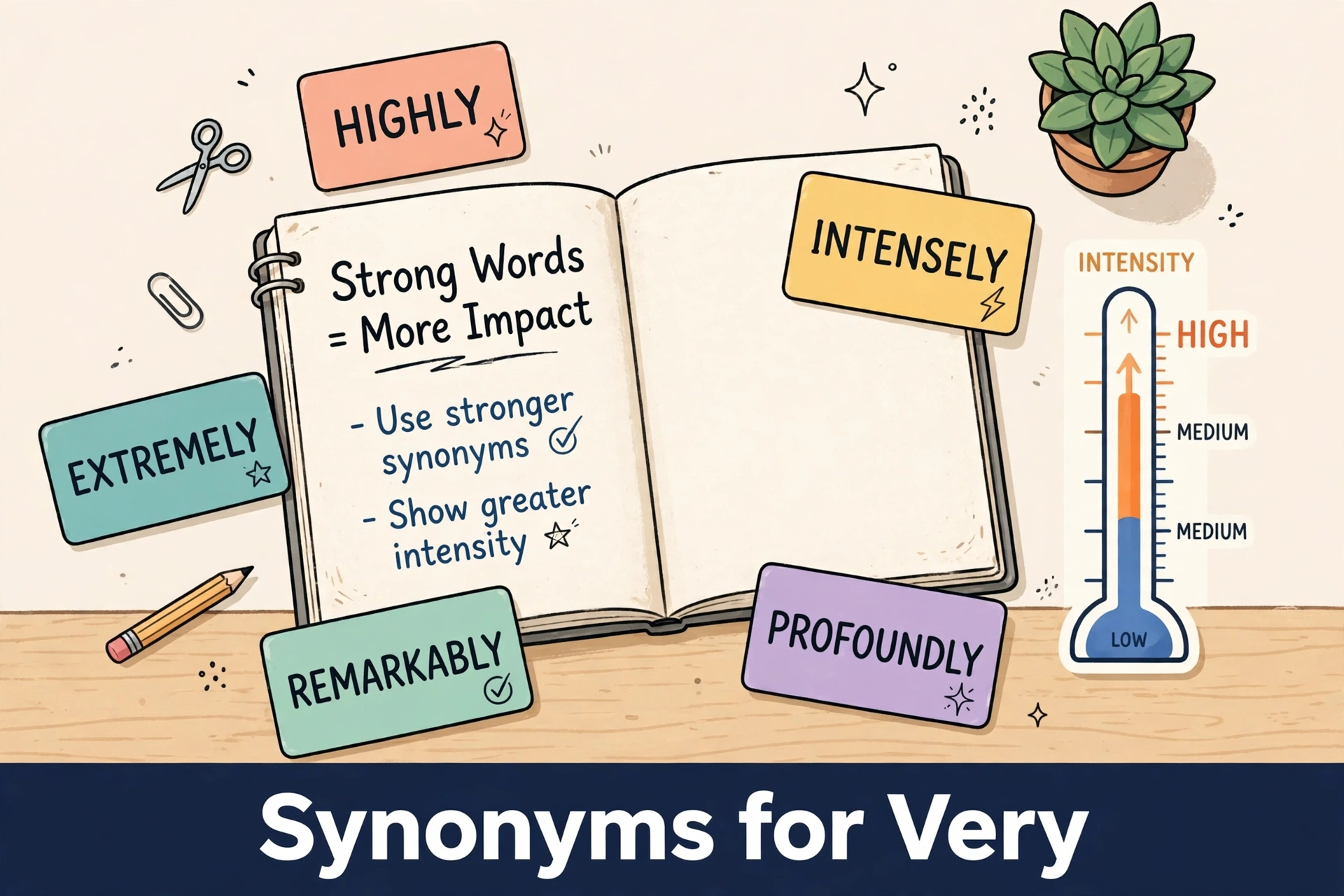
- Extremely: The safest strong choice. It means to a very high degree and fits essays, reports, and formal emails. Example: The task was extremely urgent, so the team worked late.
- Highly: Means to a high degree, often used for praise, skill, or regard. Example: She is a highly skilled teacher.
- Incredibly: Means to a degree that is hard to believe. It suits strong praise and strong reactions. Example: The view from the hill was incredibly beautiful.
- Remarkably: Means in a way worth noticing. It adds a sense of surprise to the strength. Example: He remained remarkably calm during the delay.
- Exceptionally: Means far above the usual level. It suits talent, quality, and results. Example: She gave an exceptionally clear talk.
- Immensely: Means to a very great extent, often used for feelings and effort. Example: We are immensely grateful for your help.
- Exceedingly: A formal word for extremely. It sounds old-fashioned in speech, but it works in formal writing. Example: The instructions were exceedingly clear.
- Enormously: Means to a huge extent. It fits size, effort, and importance. Example: The new library will help enormously.
- Tremendously: Means to a very great degree, often used for effort, growth, and change. Example: The team has improved tremendously this year.
- Profoundly: Means deeply and strongly, often used for feelings, change, and effect. Example: The book profoundly changed how I see the topic.
- Notably: Means in a way worth noting, but softer than extremely. It points out that something stands out. Example: The second group performed notably better.
- Particularly: Means especially or to a special degree. It works well when one case stands out from the rest. Example: The last chapter was particularly useful.
Replace Very Plus an Adjective With One Stronger Word
When you need synonyms for very, one stronger word often works best. Often the strongest writing does not swap very for another intensifier at all. It drops very and uses one precise adjective instead. This keeps sentences short and makes the meaning sharper.
| Very + adjective | One stronger word |
|---|---|
| very tired | exhausted |
| very afraid | terrified |
| very hungry | starving |
| very cold | freezing |
| very bright | dazzling |
| very interesting | fascinating |
| very important | crucial |
| very big | huge |
Use this trick when the stronger word already carries the degree inside it. Exhausted already means very tired, so very exhausted sounds wrong. When no single word fits, keep an intensifier and choose its strength with care.
How to Choose the Right Word
Use these questions to choose synonyms for very. Ask three short questions before you replace very:
- How strong is the degree? A little, a lot, or extreme?
- How formal is the writing? A message to a friend, an essay, or a work report?
- Is there one stronger word? If yes, use it and drop very.
| Situation | Better choice | Why it works |
|---|---|---|
| Everyday speech | really | It is natural and fits almost any sentence. |
| Formal praise in an essay | highly | It is strong, formal, and measured. |
| The strongest claim you can support | extremely | It is clear and safe in formal writing. |
| A single word says it all | exhausted, not very tired | One precise word is sharper than two vague ones. |
If you are unsure, choose the plainer word. Really is safer than tremendously in a casual note, and extremely is safer than exceedingly in most essays.
Sentence Examples
These before-and-after examples show how synonyms for very make meaning sharper:
- Before: She is very happy today. After: She is really happy today. The change sounds natural in everyday speech.
- Before: He is very good at maths. After: He is highly skilled at maths. The change suits formal writing and names the skill.
- Before: The film was very interesting. After: The film was fascinating. The change drops very and uses one stronger word.
- Before: We were very tired after the trip. After: We were exhausted after the trip. The change is shorter and stronger.
- Before: The result was very important. After: The result was crucial. The change says the result mattered a great deal, in one word.
Grammar and Common Mistakes
- Very before adjectives and adverbs, not verbs or nouns: Say very happy or very quickly. Do not say I very like it or a very success. Use very much for verbs, as in I like it very much.
- Very much for passives and comparatives: Say very much enjoyed and very much better, not very enjoyed or very better.
- Avoid very with absolute adjectives: Words like unique, perfect, dead, and married do not take degrees. Say truly unique only with care, and prefer one of a kind or nearly perfect when you need a qualifier.
- Do not stack very with extreme adjectives: Exhausted, freezing, and fascinating already carry high degree. Say absolutely fascinating, not very fascinating, when you need extra force.
- Very as an adjective is different: In the very same day, very means exact, not to a high degree. Do not replace it with extremely or really.
For the full dictionary senses, see the Cambridge Dictionary entry for very: https://dictionary.cambridge.org/dictionary/english/very?topic=words-and-phrases-expressing-agreement-and-acceptance
Frequently Asked Questions
What is the best synonym for very in an essay?
For synonyms for very in an essay, it depends on your point. For a safe strong choice, use extremely or highly. For something worth noticing, use remarkably or notably. For one case that stands out, use particularly. Match the strength to your evidence.
Is really a synonym for very?
Yes, in everyday use. Really works in almost any sentence where very works, and it sounds a little more natural in speech. In formal essays, extremely or highly usually read better than really.
Can I use very before a verb?
No, not on its own. Say I like it very much, not I very like it. Very goes before adjectives and adverbs, while very much goes before verbs and verb phrases.
What is the difference between very and really?
Very little in everyday speech. Really can also stress truth, as in I really mean it, while very only raises degree. In formal writing, really can sound casual, so extremely or highly is often the better pick.
Why do teachers say to avoid very?
Not because very is wrong, but because it is vague and easy to repeat. A stronger intensifier, or one precise adjective like exhausted instead of very tired, tells the reader more. Very still works when you want simple, plain emphasis.
Words to Explore Next
synonyms for really, synonyms for intense, synonyms for powerful
Conclusion
Very is useful, but it is vague. When you name the degree you mean, everyday, strong, or formal, your writing gets sharper at once. Start with really, extremely, or highly, and save the strongest words for moments that truly earn them. And when one strong adjective says it all, drop very and let that word do the work. You can find more essay-ready choices in the Writing and Essay Synonyms archive. In short, synonyms for very give you clearer choices than very alone.