20 Synonyms for Interesting: Better Words to Hold Attention
Interesting is one of the most used words in English. It can describe a book, a person, a lesson, or a fact. That range is also its weakness. It tells the reader that something caught your attention, but it does not say how, or how strongly.
This guide gives you 20 synonyms for interesting, grouped by meaning. You will learn which words fit a story that holds attention, an idea that sparks curiosity, a pleasant surprise, and a strong formal choice, so you can pick the right word the first time. Each word comes with a short note and a real example.
Quick Answer
For a story that holds attention, use fascinating or captivating. For an idea that sparks curiosity, use intriguing or thought-provoking. For a fun, pleasant experience, use entertaining or delightful. For strong, formal writing, use compelling or riveting. The best choice depends on what holds attention and how strongly it holds it.
What Does Interesting Mean?
Interesting is mainly an adjective. It describes a person or thing that keeps your attention because it is unusual, exciting, or full of ideas. The exact sense changes with context:
- Holds attention: An interesting book is hard to put down.
- Sparks curiosity: An interesting question makes you want to know more.
- Pleasant or enjoyable: An interesting evening is fun, not boring.
- Surprising or unusual: An interesting fact is one you did not expect.
Interesting does not always mean strong. A lesson can be interesting in a mild way, while a story can be so interesting that you forget the time. The synonyms below help you show that difference.
You can compare these senses in the Merriam-Webster thesaurus entry for interesting.
Synonyms That Hold Attention
Use these synonyms for interesting when something keeps you focused from start to finish.
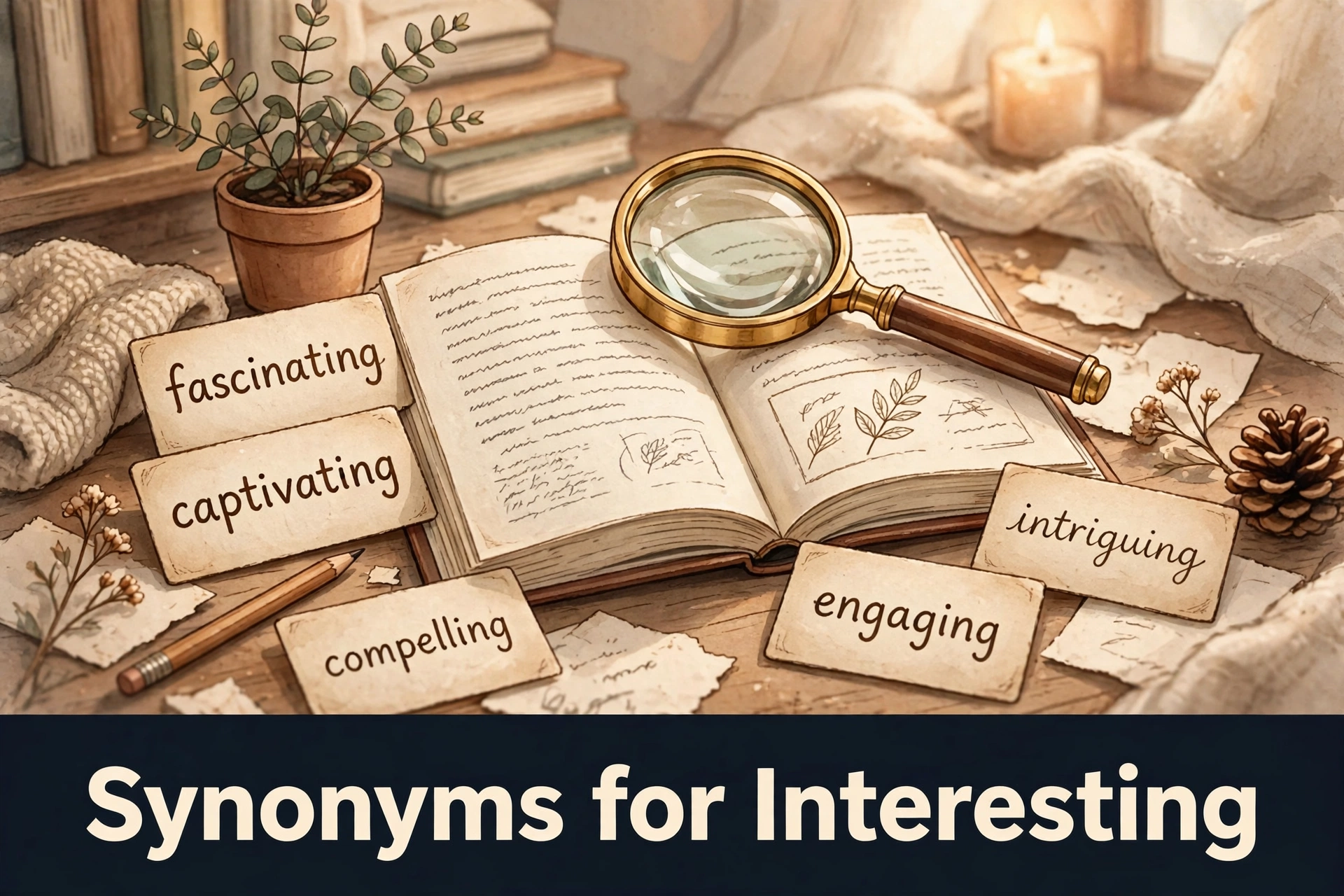
- Fascinating: Means extremely interesting, so you want to keep looking or listening. It is the strongest common choice. Example: The fascinating documentary explained how bees find their way home.
- Engaging: Means interesting in a way that pulls you in and keeps you involved. It fits talks, lessons, and books. Example: Her engaging talk made a hard topic easy to follow.
- Captivating: Means so interesting that it captures your full attention, almost like a spell. Example: The captivating story kept the whole class quiet until the end.
- Absorbing: Means so interesting that you forget everything else around you. It fits books, games, and work. Example: He found the puzzle so absorbing that he missed lunch.
- Gripping: Means exciting and interesting in a tense way, so you cannot stop reading or watching. Example: The gripping novel ended each chapter with a surprise.
Synonyms That Make You Curious
Use these synonyms for interesting when something raises a question in your mind and makes you want answers.
- Intriguing: Means interesting because it is strange or mysterious in a good way. It promises more to discover. Example: The intriguing letter had no name, only a map.
- Thought-provoking: Means it makes you think hard about an idea, often after you finish reading. Example: The thought-provoking essay asked whether robots should make decisions for us.
- Stimulating: Means it wakes up your mind and gives you new ideas. It fits talks, debates, and classes. Example: The stimulating debate gave us three new ideas for the project.
- Eye-opening: Means it shows you something new and changes how you see a topic. Example: The eye-opening visit showed us how clean water reaches a town.
- Surprising: Means interesting because it is not what you expected. Use it when the twist is the point. Example: The surprising result changed what the team believed about sleep.
Synonyms for Enjoyable and Surprising
Use these synonyms for interesting when interesting means pleasant, fun, or full of happy surprise — not just serious or deep.
- Entertaining: Means fun to watch, read, or listen to. It fits shows, books, and talks that amuse you. Example: The entertaining show mixed jokes with real science.
- Delightful: Means pleasant in a warm, joyful way. In this sense only, it works as a synonym for interesting: a delightful evening is interesting because it pleases you, not because it teaches you something deep. Example: We had a delightful evening sharing stories by the fire.
- Enjoyable: Means pleasant to do or experience. It is a safe, plain choice for most contexts. Example: The walk through the old town was enjoyable and full of small surprises.
- Lively: Means full of energy and interest, often used for talks, parties, and debates. Example: The lively class discussion kept every student talking.
- Amusing: Means funny or pleasing in a light way. It fits stories and remarks that make you smile. Example: His amusing tale about the lost dog made the whole room laugh.
Synonyms for Formal and Stronger Writing
Use these synonyms for interesting in essays, reports, and reviews when interesting is too weak for the praise you mean.
- Compelling: Means so interesting and strong that you must pay attention, often because the case or story is powerful. Example: She gave a compelling reason to save the old library.
- Riveting: Means so interesting that you cannot look away, like a great performance or speech. Example: The riveting speech held the crowd in silence.
- Spellbinding: Means fascinating in a magical, almost unreal way. Save it for rare moments. Example: The spellbinding tale of the mountain climbers kept us reading late.
- Unforgettable: Means so interesting or striking that you remember it long after. Use it for moments, not for plain facts. Example: The trip gave us an unforgettable view of the desert at dawn.
- Noteworthy: Means interesting because it is worth noticing or recording, often in formal writing. Example: The report noted one noteworthy change in student reading habits.
How to Choose the Right Word
Ask three short questions before you replace interesting: Use them to pick synonyms for interesting.
- What holds attention? A story, an idea, a person, or an experience?
- How strong is it? Mildly pleasant, truly curious, or impossible to ignore?
- Who will read it? A friend, a teacher, or a formal reader?
| Situation | Better choice | Why it works |
|---|---|---|
| A book you cannot put down | gripping | It shows tension and a pull to keep reading. |
| A question with no easy answer | thought-provoking | It shows the idea makes you think. |
| A fun evening with friends | delightful | It shows pleasure, not just attention. |
| A strong case in an essay | compelling | It shows force, not just mild interest. |
| A strange fact you want to explore | intriguing | It shows mystery and a wish to know more. |
If you are unsure, pick the plainer word. Fascinating is safer than spellbinding in most essays, and engaging is safer than riveting for a normal lesson. That rule works well for synonyms for interesting.
Sentence Examples
These before-and-after examples show how the meaning gets sharper using synonyms for interesting.
- Before: It was an interesting book. After: It was a gripping book. The change says the book was tense and hard to put down.
- Before: She asked an interesting question. After: She asked a thought-provoking question. The change says the question made people think.
- Before: We had an interesting evening. After: We had a delightful evening. The change shows the evening was pleasant and joyful.
- Before: The talk was interesting. After: The talk was engaging. The change says the talk pulled listeners in and kept them involved.
- Before: It was an interesting speech. After: It was a riveting speech. The change raises the praise to a level where no one could look away.
- Before: That is an interesting fact. After: That is an intriguing fact. The change says the fact is strange enough to make you want to learn more.
Grammar and Common Mistakes
- Interesting vs. interested: The -ing form describes the thing. The -ed form describes the person feeling it. Say “The book is interesting” for the book. Say “I am interested in the book” for your feeling.
- Interested in + noun or verb-ing: Use interested in before a noun or a verb ending in -ing, as in “interested in science” or “interested in learning science.” Do not say “interested to science.”
- Interesting vs. interested in a person: “She is interesting” means she holds attention. “She is interested” means she wants to know more. The two meanings are easy to mix up, so check which one you mean.
- Do not stack strong words: Riveting already means very interesting, so “very riveting” sounds too much. Use riveting on its own.
- Interesting for people, with care: Calling a person interesting is usually praise. In a joking tone, though, “interesting” can mean strange, as in “That is an interesting hat.” Check your tone so the praise is clear.
For the full dictionary senses, see the Cambridge Dictionary entry for interesting.
Frequently Asked Questions
What is the best synonym for interesting in an essay?
It depends on your point. For a strong case, use compelling. For an idea that makes readers think, use thought-provoking. For a story that holds attention, use engaging or captivating. Match the word to your evidence, not just to a fancier word.
What is the difference between interesting and interested?
Interesting describes the thing that holds attention, as in “an interesting film.” Interested describes the person who feels that attention, as in “I am interested in the film.” Use -ing for the thing and -ed for the person.
Is fascinating stronger than interesting?
Yes. Interesting means something holds your attention. Fascinating means it holds your attention fully and strongly, often with wonder. Save fascinating for topics that truly amaze you.
Can I use delightful as a synonym for interesting?
Only in the pleasant sense. A delightful evening is interesting because it pleases you. A delightful fact, though, sounds odd unless the fact itself brings joy. For facts and ideas, use intriguing or eye-opening instead.
What is a formal synonym for interesting?
Compelling and noteworthy suit formal writing. Compelling fits a strong argument or story. Noteworthy fits a fact or change worth recording. Riveting is strong too, but it suits performances and speeches more than reports.
Is intriguing the same as interesting?
Not quite. Interesting is broad. Intriguing is narrower: it means interesting because something is mysterious or strange, and you want to know more. If there is no mystery, engaging or fascinating may fit better.
Words to Explore Next
synonyms for interested, synonyms for boring, synonyms for intriguing
Conclusion
Interesting is useful, but it is vague. When you name what holds attention — a gripping story, an intriguing question, a delightful evening, or a compelling case — your writing becomes clearer at once. Start with fascinating, engaging, intriguing, or compelling, and save the strongest words for moments that truly earn them. For more guides like this one, browse the Writing & Essay Synonyms archive. Keep this list of synonyms for interesting handy when you revise.